Custom AI Solutions for Business: When Off-the-Shelf Tools Aren't Enough
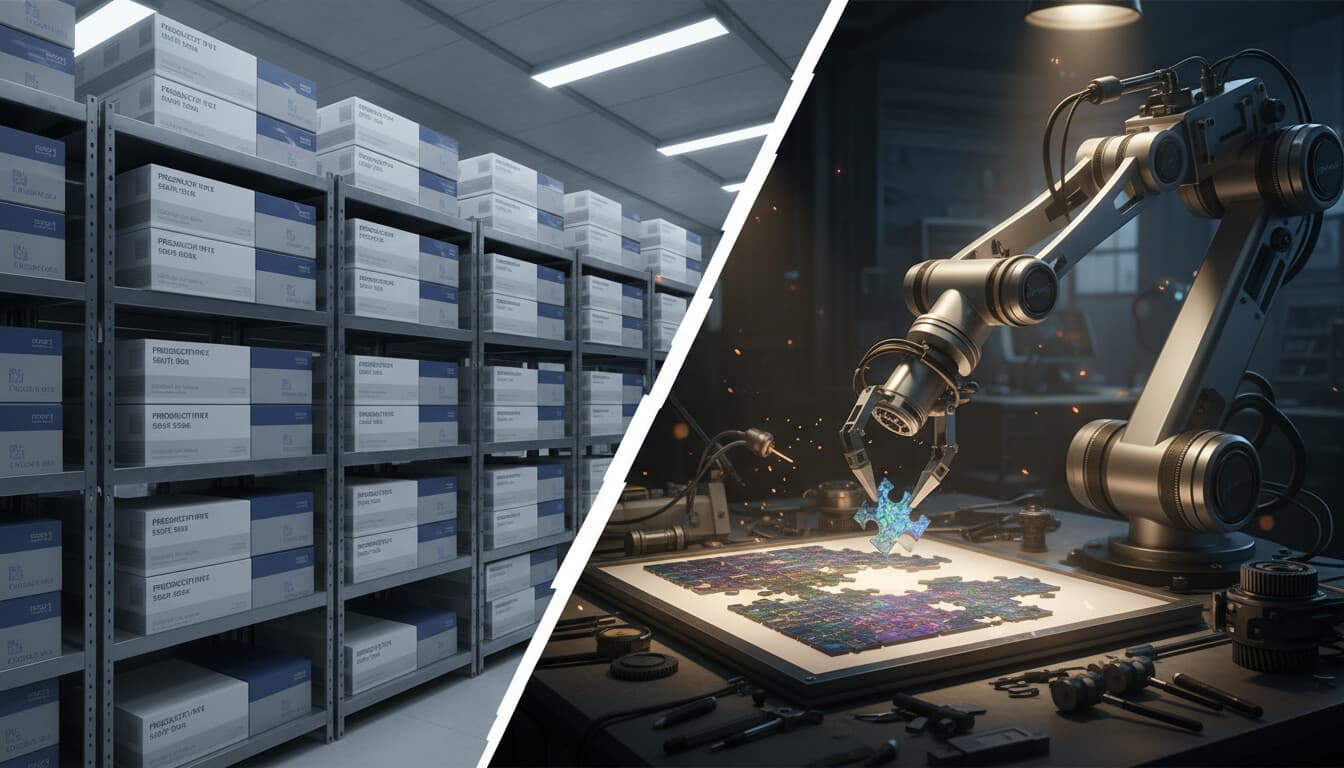
Every week, someone asks us whether they should build a custom AI solution or use an existing tool. It's the right question to ask. The answer depends on your specific situation.
Off-the-shelf AI tools handle 80% of use cases well. They're faster to implement, cheaper to maintain, and constantly improved by vendors. But for that remaining 20%, custom AI solutions for business can be the difference between adequate and exceptional.
When Off-the-Shelf Works Fine
Let's start with when you don't need custom solutions. This covers most businesses.
Generic processes that many businesses share. Email marketing, basic chatbots, lead scoring, expense processing, meeting transcription. These problems have been solved many times. The tools are mature and work well.
When you're just getting started with AI. If you haven't implemented any AI tools yet, start with proven off-the-shelf options. You'll learn what works for your team and identify genuine gaps before investing in custom development.
When time matters more than perfection. Custom development takes months. If you need results next quarter, buy something that works well enough.
When the budget is tight. Custom AI projects rarely cost less than $20,000, and many run $50,000 to $200,000 or more. If that budget isn't available, focus on making existing tools work better.
The majority of businesses will get excellent results from combining existing AI tools with smart implementation. Don't assume you need custom just because you're "different." Every business thinks they're different. Usually, they're not.
When Custom AI Actually Makes Sense
Now for the scenarios where custom solutions genuinely provide value.
Your Competitive Advantage Depends on It
If AI directly creates differentiation in your market, building it yourself might make strategic sense. A logistics company that develops proprietary routing algorithms optimized for their specific delivery patterns creates something competitors can't just buy.
But be honest with yourself. "Our sales process is unique" usually isn't true. "We have proprietary data on regional delivery patterns across 15 years that no one else has" might be.
Off-the-Shelf Tools Genuinely Don't Exist
Some problems are too specific or too niche for vendors to build products around. If you've looked seriously and there's nothing that addresses your use case, custom development becomes the only option.
Example: A medical device manufacturer needed AI to analyze images from a proprietary diagnostic machine. No existing tool handled their specific image format and diagnostic requirements. Custom was the only path.
Integration Complexity Exceeds Tool Capabilities
Sometimes the challenge isn't any single AI task, but connecting multiple systems in ways that existing tools can't handle. If you need AI that works across a legacy ERP, custom internal databases, and specific industry platforms, custom integration might be necessary.
Volume Makes Unit Economics Work
AI tools that charge per transaction (per invoice, per API call, per message) can become expensive at scale. A business processing millions of transactions might find that the development cost of a custom solution pays back in reduced per-unit costs.
Run the math. If you're paying $0.10 per document and processing 100,000 monthly ($10,000), a custom solution costing $80,000 to build might pay back in under a year.
Regulatory or Security Requirements
Some industries can't use cloud-based AI tools because of data residency, compliance, or security requirements. Healthcare, defense, financial services, and others sometimes need on-premise AI that they control completely.
What Custom AI Development Actually Looks Like
If you're considering custom development, understanding the process helps you plan and budget realistically.
Phase 1: Discovery and Scoping (2-4 weeks)
Before any code is written, you need to define exactly what you're building. This includes documenting the business process in detail, identifying data sources, setting success metrics, and creating technical specifications.
This phase often reveals that the problem can actually be solved with existing tools, or that the data required doesn't exist, or that the ROI doesn't justify the investment. Better to discover this in week 3 than month 6.
Phase 2: Data Preparation (2-8 weeks)
AI runs on data. This phase involves collecting, cleaning, and organizing the data your system will learn from. For many projects, this is the longest and most tedious phase.
If your data is scattered, inconsistent, or incomplete, this phase takes longer. Sometimes it reveals that you don't have enough data to train an effective model.
Phase 3: Model Development (4-12 weeks)
This is the actual AI development: building and training models, testing approaches, iterating based on results. The timeline depends heavily on complexity and how much experimentation is needed.
Simple classification or extraction tasks can work quickly. Complex prediction or generation tasks may require multiple approaches before finding something that performs well.
Phase 4: Integration and Deployment (2-6 weeks)
The AI model needs to connect to your actual business systems. This means building APIs, creating user interfaces, setting up monitoring, and deploying to production infrastructure.
Integration work often takes longer than expected because of quirks in existing systems.
Phase 5: Refinement and Iteration (Ongoing)
No AI system is perfect at launch. Plan for a period of monitoring, gathering feedback, and improving performance. This might mean retraining models with new data, adjusting thresholds, or building additional features.
Total timeline for a custom AI project typically runs 3 to 9 months for meaningful implementations. Simpler projects can be faster. Complex ones can take longer.
What Custom AI Costs
Budget is usually the deciding factor. Here's what to expect for different project types.
Simple AI automation or integration: $15,000 to $40,000 Connecting existing AI capabilities to your systems, building custom workflows, basic model fine-tuning. Examples: custom chatbot with specific knowledge base, automated document processing for unique formats.
Moderate custom AI development: $40,000 to $100,000 Building new models trained on your data, more complex integration requirements, custom interfaces. Examples: predictive models using company-specific data, AI that works with proprietary systems.
Complex AI systems: $100,000 to $300,000+ Multiple integrated AI components, real-time processing requirements, significant data engineering. Examples: comprehensive AI assistants, computer vision systems, enterprise-wide AI platforms.
These are rough ranges. Actual costs depend on technical complexity, data availability, integration requirements, and who you hire to build it.
The ongoing costs matter too. Custom AI systems need maintenance: model retraining, infrastructure costs, monitoring, updates as your business changes. Budget 15-25% of initial development cost annually for maintenance.
Build In-House vs. Hire an Agency vs. Use a Contractor
You have three basic options for custom AI development.
Building in-house makes sense if you have ongoing AI needs that justify dedicated staff. The challenge: finding and retaining AI talent is competitive and expensive. A capable ML engineer costs $150,000 to $250,000 annually in most markets.
Hiring an agency provides access to experienced teams who've built similar systems before. They're faster because they're not learning on the job. The tradeoff: you're dependent on them for changes and maintenance, and agency rates run $150 to $300+ per hour. For help deciding between options, see DIY automation vs hiring an agency.
Using a contractor or freelancer can work for smaller projects with clear specifications. Rates are lower, but you're betting on a single person's capabilities and availability.
For most businesses, an agency makes sense for initial development, potentially transitioning to in-house or contractor for ongoing maintenance once the system is stable.
Questions to Ask Before Starting
Before committing to custom development, work through these questions.
What specific problem are we solving, and what does success look like? Vague goals lead to failed projects. "Use AI to improve operations" isn't specific enough. "Reduce invoice processing time from 8 hours weekly to 2 hours" is.
What data do we have, and is it sufficient? AI needs training data. If you don't have enough examples of the thing you're trying to predict or automate, the project won't succeed.
Have we genuinely evaluated off-the-shelf alternatives? Not a cursory look, but real evaluation with trials and demos. Sometimes the right tool exists and you just haven't found it.
What's the ROI case? Build a financial model. If the system costs $80,000 to build and $20,000 annually to maintain, what savings or revenue does it need to generate to justify that? Our guide on custom AI workflow costs breaks down typical pricing in more detail.
Who will own this internally? Custom AI needs a business owner who understands it, champions it, and drives adoption. Without internal ownership, even well-built systems fail.
What happens when the AI is wrong? All AI systems make mistakes. What's the fallback? What's the impact of errors? How will you catch and correct them?
A Realistic Perspective
We build custom AI solutions for clients. We also frequently tell people they don't need custom development.
The most common situation we see: a business assumes they need custom because their process feels unique. After exploring the problem, we find an existing tool that handles 90% of the need at a fraction of the cost.
Custom AI makes sense in specific circumstances. For most businesses, the path is: implement proven tools first, identify genuine gaps, then consider custom solutions for the pieces that off-the-shelf can't handle.
If you're trying to figure out whether custom AI development is right for your situation, reach out to us. We'll give you an honest assessment. Sometimes that means we build something for you. Sometimes it means pointing you toward existing tools. Our goal is finding the right solution, not selling you a project.
You can also see how we approach these projects to understand our process.