AI for Business: 25 Real Use Cases That Save Time & Increase Revenue
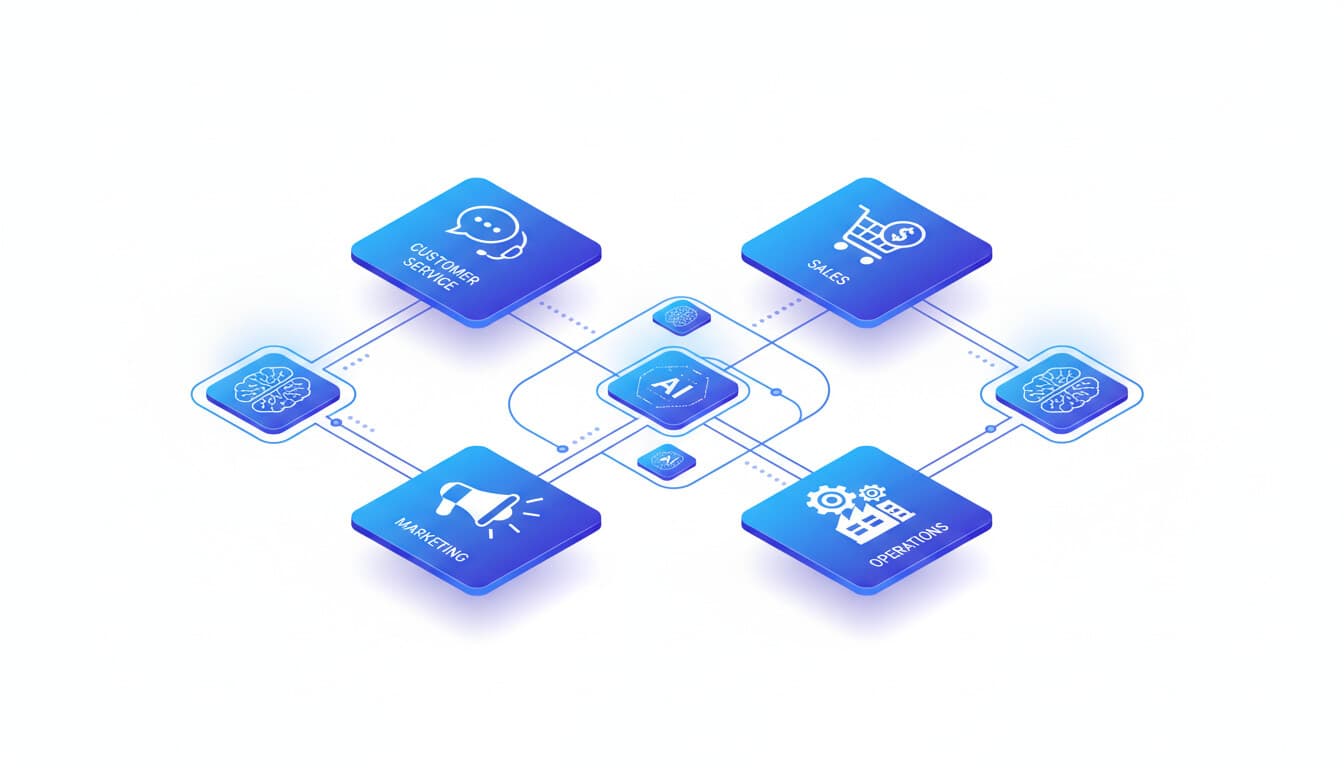
Talking about AI in the abstract is easy. Everyone says it'll change everything. But what does AI for business actually look like in practice? What are real companies doing with it right now?
We compiled 25 use cases from businesses we've worked with and studied. These aren't theoretical possibilities. They're implementations running today, with measurable results.
Customer Service and Support
1. First-Response Chatbots
A regional insurance agency receives about 300 customer inquiries weekly. Before AI, their 4-person support team was constantly behind. They implemented a chatbot that handles initial contact, answers common questions, and collects information before routing complex issues to humans.
Result: 67% of inquiries resolved without human involvement. Average response time dropped from 4 hours to 12 seconds.
2. Email Triage and Auto-Response
A B2B software company gets 150+ support emails daily. Their AI email system now categorizes incoming messages by urgency and topic, drafts responses for common issues, and prioritizes the queue for their support team.
Result: Support team handles 40% more tickets per day. Customer satisfaction scores increased 18% because urgent issues get faster attention.
3. Sentiment Analysis for Escalation
A hotel chain uses AI to analyze customer messages across email, chat, and social media. When the system detects frustration, anger, or mentions of competitors, it immediately flags the conversation for manager review.
Result: They catch and resolve 89% of potential churn situations before the customer leaves a negative review or cancels their booking.
4. 24/7 Booking and Scheduling
A dental practice with 3 locations implemented an AI scheduling assistant. Patients can book, reschedule, or cancel appointments via chat or voice at any hour. The system knows which procedures need which equipment and staff, preventing scheduling conflicts automatically.
Result: After-hours booking increased appointment volume by 23%. No-shows dropped 31% because of automated reminders with easy rescheduling options.
5. Multilingual Support Without Hiring
A Shopify store selling globally used to only offer English support. AI translation now lets their 2-person team handle inquiries in 12 languages. The system translates incoming messages, suggests responses, then translates outgoing replies.
Result: International sales increased 34% after customers could get support in their language. Support costs stayed flat.
Sales and Lead Management
6. Lead Scoring That Actually Works
A commercial real estate firm receives leads from multiple sources: website forms, Zillow, cold outreach responses, referrals. Their AI lead scoring system analyzes each lead's behavior, company data, and message content to predict likelihood to close.
Result: Sales team focuses on top-scored leads first. Close rate improved from 8% to 14%. Average deal size increased because reps spend more time on qualified opportunities.
7. Automated Follow-Up Sequences
A SaaS company selling to small businesses uses AI to personalize follow-up emails based on how prospects interact with their site. Someone who spent time on the pricing page gets different messaging than someone who read case studies.
Result: Email reply rates increased 52%. Pipeline velocity improved by 3 weeks on average.
8. Meeting Scheduling Without the Back-and-Forth
A consulting firm wasted hours weekly on the scheduling dance. Their AI assistant now handles all meeting coordination, checking calendars, suggesting times, and handling the entire email thread until the meeting is booked.
Result: Consultants save average of 5 hours weekly on scheduling. Client experience improved because booking takes one email instead of six.
9. Proposal Generation
A marketing agency uses AI to draft initial proposals based on client conversations and past similar projects. The system pulls relevant case studies, suggests pricing based on scope, and formats everything to brand standards.
Result: Proposal turnaround dropped from 3 days to 4 hours. Win rate stayed consistent while volume of proposals increased 60%.
10. Competitive Intelligence Monitoring
A manufacturing supplier uses AI to monitor competitor websites, press releases, pricing changes, and social media. The system surfaces relevant changes and suggests responses or opportunities.
Result: They identified 3 major opportunities in 6 months where competitor issues created openings. Won $2.3M in new business directly attributed to competitive intelligence.
Operations and Workflow
11. Invoice Processing and AP Automation
An e-commerce company processes 800+ invoices monthly from suppliers. AI reads each invoice (PDF, email, paper scan, whatever format), extracts the data, matches it to purchase orders, and queues everything for approval. This kind of workflow automation is increasingly common in finance operations.
Result: AP processing time dropped from 12 hours weekly to 2 hours. Late payment penalties eliminated. Early payment discounts captured more consistently.
12. Inventory Demand Forecasting
A retailer with 4 locations uses AI to predict inventory needs based on historical sales, local events, weather forecasts, and promotional calendars. The system suggests order quantities and timing automatically.
Result: Stockouts reduced 45%. Overstock situations reduced 38%. Cash flow improved because capital isn't tied up in excess inventory.
13. Document Search and Knowledge Management
A law firm with 15 years of case files implemented AI-powered document search. Attorneys can ask natural language questions like "find all contracts with auto-renewal clauses from tech clients" instead of manually searching.
Result: Research time for typical matters dropped 60%. Junior associates can find relevant precedents that previously required partner involvement.
14. Quality Control in Manufacturing
A food production facility uses computer vision AI to inspect products on the production line. The system catches defects, contamination, and packaging errors faster and more consistently than human inspectors.
Result: Defect detection rate improved 34%. Customer complaints dropped 47%. They maintained quality while increasing line speed 15%.
15. Expense Report Processing
A company with 60 traveling employees used to have an admin spend 20+ hours monthly processing expense reports. AI now reads receipts, categorizes expenses, checks policy compliance, and flags exceptions.
Result: Processing time dropped to 4 hours monthly. Compliance issues caught 3x more often. Employees get reimbursed faster.
Marketing and Content
16. Product Description Generation
An online retailer with 5,000+ SKUs needed product descriptions updated for SEO. AI generates initial drafts based on product specs, photos, and category best practices. Human editors review and refine.
Result: Completed catalog update in 6 weeks instead of projected 8 months. Organic search traffic increased 28% over 6 months.
17. Social Media Content Creation
A restaurant group manages social presence for 8 locations. AI suggests post ideas based on what's performed well, local events, and trending topics. Generates draft copy and recommends posting times.
Result: Social engagement increased 67%. Time spent on social management dropped 50%. More consistent posting across all locations.
18. Email Subject Line Optimization
A nonprofit running regular fundraising campaigns uses AI to test and optimize email subject lines. The system predicts open rates and suggests variations based on their audience's past behavior.
Result: Average open rates improved from 22% to 31%. One campaign saw 44% higher donations directly attributed to better email performance.
19. Ad Copy Testing
A DTC brand uses AI to generate variations of ad copy for Facebook and Google. The system learns which messaging resonates with different audience segments and automatically shifts budget toward winners.
Result: Cost per acquisition dropped 23%. ROAS improved from 2.8x to 3.9x over 4 months.
20. Customer Review Response
A multi-location service business gets 50+ reviews weekly across Google, Yelp, and Facebook. AI drafts personalized responses to each review, incorporating specific details from the customer's feedback.
Result: Response rate went from 30% to 95%. Review volume increased 40% as customers saw the business was responsive.
Finance and Analytics
21. Cash Flow Forecasting
A construction company with variable project timelines uses AI to predict cash flow based on project schedules, historical payment patterns, and seasonal factors. The system alerts to potential shortfalls 6-8 weeks in advance.
Result: Eliminated 2 cash crises in year one that would have required emergency credit lines. Better visibility enabled taking on larger projects.
22. Fraud Detection
An e-commerce business losing 2.3% of revenue to fraud implemented AI fraud screening. The system evaluates orders based on hundreds of signals, blocking obvious fraud while flagging borderline cases for review.
Result: Fraud losses dropped to 0.4%. False positive rate (legitimate orders blocked) stayed under 0.5%. Manual review workload decreased 70%.
23. Pricing Optimization
A regional hotel chain uses AI to adjust room rates based on demand signals: local events, competitor pricing, booking pace, weather, and historical patterns. Rates update multiple times daily.
Result: Revenue per available room increased 12%. Occupancy remained steady because the system knows when to drop prices to fill rooms.
24. Customer Lifetime Value Prediction
A subscription business uses AI to predict which customers are likely to churn and which are likely to become high-value. This drives targeted retention efforts and acquisition strategy.
Result: Reduced churn 19% by intervening with at-risk customers. Increased marketing spend efficiency by focusing acquisition on profiles matching high-value customers.
25. Financial Statement Analysis
An accounting firm uses AI to analyze client financial statements, identifying anomalies, trends, and areas of concern. The system generates preliminary observations that accountants review and refine.
Result: Analysis time per client dropped 40%. More consistent identification of issues across all clients, not just the ones that get extra attention.
What These Examples Have in Common
Looking across all 25 use cases, patterns emerge. Successful AI for business implementations share characteristics.
They solve specific, measurable problems. Not "use AI" but "reduce invoice processing time" or "improve lead conversion rate." Clear problems lead to clear solutions. If you're not sure where to start, see our guide to automating business processes.
They start with existing data. Every successful implementation built on data the business already had: customer emails, transaction records, documents, behavior logs. AI needs fuel to work.
They keep humans in the loop. None of these examples fully removed human judgment. They amplified human capability, handled routine work, and surfaced insights. The human-AI collaboration is what creates real value.
They deliver ROI quickly. Most showed measurable results within 30 to 90 days. Long implementation timelines kill projects. Quick wins build momentum.
Getting Started
Which of these use cases matches a problem you're facing? That's your starting point.
We help businesses implement AI solutions like these every day. If you're curious about what's possible for your specific situation, explore our solutions or schedule a free consultation. We'll show you exactly which AI applications make sense for your business and what results you can realistically expect.